
Van Buren County Criminal History Checks
No single official system contains every Van Buren County criminal record. Begin at the county Circuit Court Case Information route and search both local MiCOURT deployments. The 7th District Court holds misdemeanors and the first stage of every adult felony. The 36th Circuit Court holds a felony after bindover. Search both if the offense level or case stage is not known. A party name can find a docket, but a case number is the better match when it is available.
Build the check in layers. Court dockets show filed charges, events, and outcomes. ICHAT provides Michigan’s public repository summary. The current jail roster shows present county custody, while OTIS covers qualifying MDOC custody and supervision. Older files, certified judgments, transcripts, and exhibits may require the clerk. Use this order:
- Search the 7th District and 36th Circuit court indexes with the full name, spelling variants, or a known case number.
- Confirm the court, filing date, case status, charge, and event history before deciding that a result belongs to the right person.
- Run an ICHAT name check when a statewide public Michigan summary is useful, knowing that its scope is narrower than all local files.
- Check the sheriff roster or OTIS when the question concerns current custody, prison, parole, or qualifying felony probation.
- Ask the correct clerk or records-owning agency for a certified copy, police report, or file that is not available online.
The official Van Buren County home page is the source for current department routing and service notices.

That county hub helps a searcher reach the office that owns the requested record instead of sending every question to one counter.
Why Van Buren Record Searches Fall Short
Each Van Buren County system answers a different question. MiCOURT is a case index. It can show the court, case number, charges, status, scheduled events, disposition, and financial entries that are public. ICHAT is a repository product built from reportable Michigan arrest and disposition data. It omits warrants, federal and tribal matters, traffic records, juvenile records, suppressed records, local misdemeanors, and records from other states. A “no record” ICHAT result therefore does not prove that no other official record exists.
The sheriff roster is more current but much narrower. It is a snapshot of people presently held in the Van Buren County Jail, not a historical arrest log. OTIS is different again. It covers Michigan prisoners, parolees, probationers supervised by MDOC, and people discharged within the prior three years. The safest reading comes from comparing record type, date, court, and status. A recent booking may reach the jail roster before it reaches MiCOURT or ICHAT, and the final court charge can differ from the charge shown at intake.
Official Background Checks in Michigan
The Michigan State Police Criminal Justice Information Center maintains the state repository. Its public name-search product, ICHAT, requires first name, last name, date of birth, and sex or gender. A standard query costs $10 at checkout. The result includes public Michigan information within the repository’s rules, such as reported felony arrests and convictions and serious misdemeanor convictions. It is not a copy of a Van Buren County police report, court file, warrant list, or nationwide record.
For a person reviewing their own fuller Michigan record, fingerprints are the stronger identity match. The person obtains a Michigan Applicant Fingerprint Card, RI-008, and sends the card, a cover letter, and $30 to MSP CJIC. MSP mails the response only to the person printed and advises allowing three to five weeks including mail. The sheriff also provides local Live Scan and wet-ink services for authorized needs.
| Official product | Fee | Main limit or detail |
|---|---|---|
| ICHAT name search | $10 | Public Michigan repository subset |
| MSP personal fingerprint review | $30 | Sent only to the printed person; $1 per extra original |
| Sheriff Live Scan | $65 exact cash | Local capture for an authorized check |
| Sheriff wet-ink card | $20 | $10 for each added card |
| Local MiCOURT index | Free online | Copies or certification may cost extra |
Van Buren Records Around Paw Paw
Van Buren County’s main records offices sit close together in Paw Paw, yet they remain separate custodians. The courthouse at 212 E Paw Paw Street houses the 36th Circuit Court, the Paw Paw location of the 7th District Court, and the local MDOC probation and parole suite. The Sheriff and Jail are at 205 S Kalamazoo Street. County administration is at 219 E Paw Paw Street, Suite 302. A short walk does not turn those offices into one records desk.
Send court-file questions to the clerk, report and booking questions to the sheriff, and supervision questions to the right court probation unit or MDOC office. The sheriff location is also the local fingerprint channel. Regular fee service is offered Monday through Thursday from 7:30 a.m. to 4:30 p.m., excluding holidays. It requires valid government photo identification and exact cash. Court-ordered fingerprints follow different acceptance procedures.
Van Buren Sheriff and Jail
205 S Kalamazoo Street
Paw Paw, MI 49079
Records, current custody, bonds, and fingerprint service
ICHAT Limits for Van Buren Records
ICHAT works best when the searcher understands both its fields and its exclusions. First and last names, date of birth, and sex or gender are required. An exact birth date helps reduce false matches, but the query is still based on a name rather than a fingerprint. Review identifiers and each arrest-disposition cycle. Do not treat a similar name as proof of identity.
The Michigan State Police criminal history overview explains which official product fits a name search, fingerprint review, or correction request.
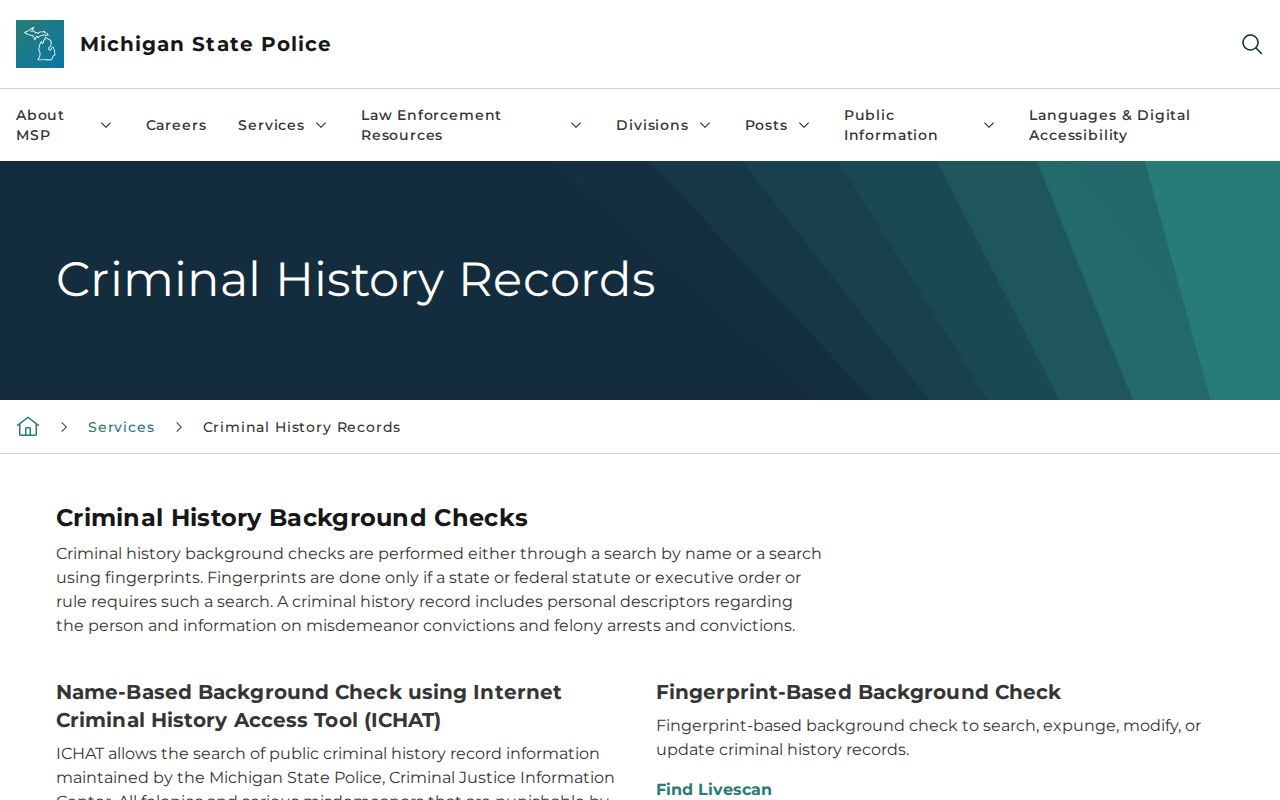
The state overview also makes clear that a repository summary cannot replace the Van Buren County case docket or the record held by the arresting agency.
| ICHAT field | Required | How to use it |
|---|---|---|
| First name | Yes | Use the legal spelling and review known variants |
| Last name | Yes | Check prior names when they are relevant to self-review |
| Date of birth | Yes | An exact date helps narrow a common name |
| Sex or gender | Yes | Use the portal’s current choice field |
| Checkout | Applies | The standard public search costs $10 |
Kinds of Criminal Records
A Van Buren County criminal record begins with the office that creates it. A deputy, city officer, or MSP trooper writes the incident or arrest report. The jail creates the booking entry, custody status, bond data, photograph, and fingerprints. The prosecutor reviews a warrant request and selects the charge to authorize. The courts then create dockets, filed pleadings, orders, judgments, and sentence entries. MSP compiles reportable data into the state repository.
Those sources should not be merged into one label. A warrant is issued by a court and carried out by law enforcement. Probation is a court sentence, while parole follows a state prison term. A police report narrates the agency response; it is not the court’s finding. The county’s centralized official forms center shows the separate routes for FOIA, court, sheriff, and public-defender forms.
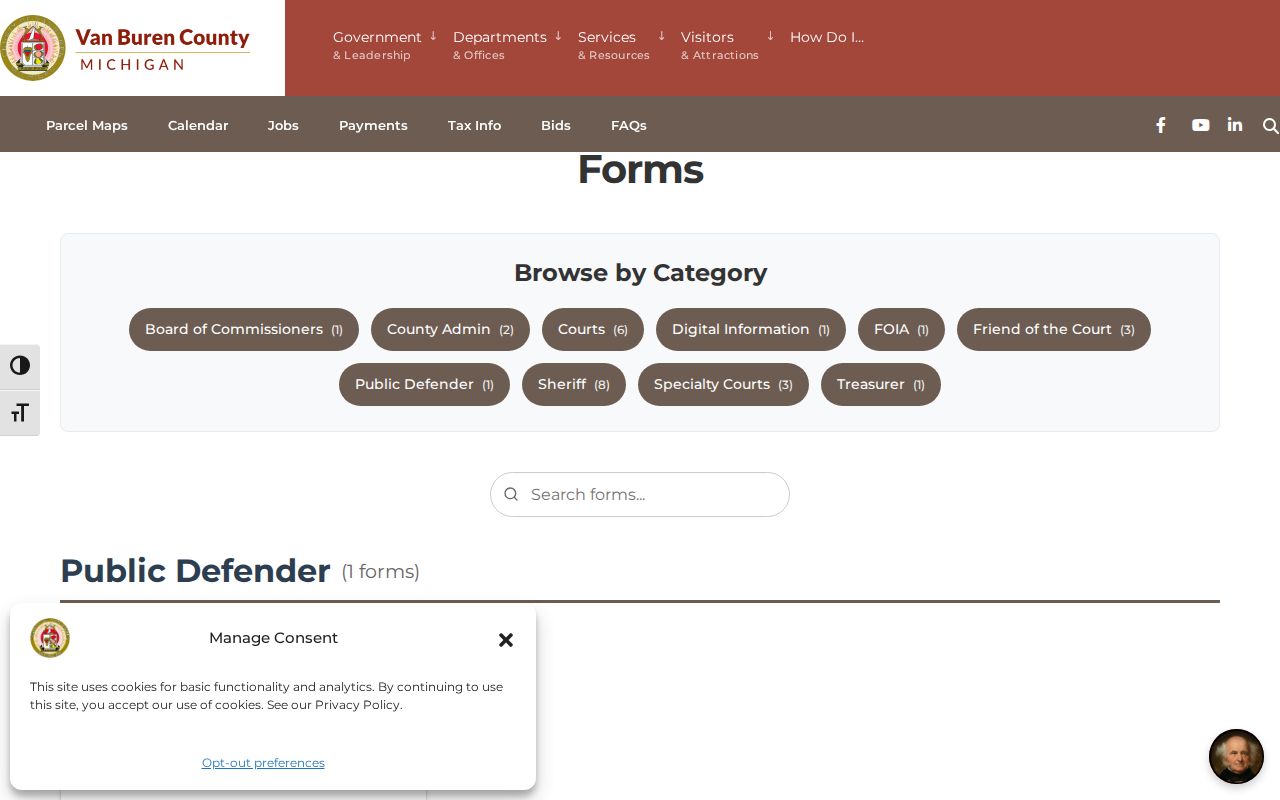
The forms page reflects the local system’s core rule: choose the form and custodian that match the record, not merely the county name.
- Booking
- Jail intake that creates custody, identity, fingerprint, photograph, charge, and bond data.
- Docket
- The court’s dated index of filings, hearings, orders, and other case events.
- Disposition
- The result of a charge or case, such as conviction, dismissal, or acquittal.
- Bindover
- Transfer of a supported felony from District Court to Circuit Court.
- Set-aside
- Michigan relief that makes an eligible conviction nonpublic for ordinary purposes.
Van Buren Custody Record Locators
Use the Van Buren County Jail roster for current county custody. The Sheriff’s Corrections Division operates one adult facility in Paw Paw with space for 213 inmates. Its roster is a live status tool, not a full booking archive. If a name no longer appears, the person may have been released, transferred, moved to another jail, or never booked there. Check the court docket for the charge and next hearing, and use MI-VINE or VINELink for custody and release notifications.
OTIS answers a different question. It lists qualifying MDOC prisoners, parolees, felony probationers, and recent discharges within its coverage window. The Michigan Department of Corrections source identifies the state system and its official services.
This state layer matters after a transfer or sentence, but it does not supply the sheriff’s booking report or the court’s complete Van Buren County case file.
Van Buren County Criminal Records: What They Contain
The fields depend on the source. A fingerprint-linked MSP history organizes identity data around arrest cycles and reported outcomes. A MiCOURT entry adds the filed case number, court, status, charges, hearing events, judge, disposition, sentence, and public financial entries. The Van Buren jail roster focuses on custody, booking, charges, and bond. Read the field beside its source and date.
Protected identifiers, victim information, juvenile material, and sealed items should not appear like an ordinary adult public record. Some court documents also require a clerk request even when the docket can be viewed online.
| Name and identifiers | Legal and prior names, date of birth, descriptors, marks, aliases, and agency numbers within the source’s access rules. |
|---|---|
| Arrest and booking | Agency, date, booking number, intake status, alleged offenses, fingerprints, and bond data. |
| Charges and statutes | Arrest allegations, prosecutor-authorized counts, court charge text, and Michigan law references. |
| Case events | Arraignment, probable-cause conference, preliminary examination, motions, plea, trial, and scheduled hearings. |
| Disposition and sentence | The final result for each count and any public sentence, cost, restitution, or supervision entry. |
| Custody or supervision | County jail status, MDOC location, probation, parole, discharge, or transfer information within the chosen locator. |
Van Buren Booking Charges Can Change
A booking charge is an allegation recorded during jail intake. It is not the final result. The arresting officer first documents probable cause. The prosecutor may authorize a different charge, decline a count, or add a count supported by the evidence. The 7th District Court then handles arraignment, bond, and the early felony steps. A supported felony moves to the 36th Circuit Court, where later pleas, trial rulings, and sentencing appear.
Compare the dates and labels before drawing a conclusion. “Pending” is not a conviction. A dismissal ends a charge without a conviction but is not the same event as an acquittal after trial. The final conviction offense may also differ from both the police allegation and the first complaint. For that reason, use the court disposition when the question is how the case ended, and use the agency or jail record only for what happened at arrest and intake.
Note: A Van Buren County arrest record documents custody and allegations; guilt is decided through the court process, not at booking.
Michigan Public Access Laws
Michigan law divides access by custodian. FOIA governs records held by public bodies, subject to exemptions, but judicial case access follows court rules and clerk procedures. The Sheriff or city police department handles its incident report. The Van Buren County Jail handles booking and custody records. Court clerks manage filed cases. MSP controls repository history, and MDOC controls state custody and supervision data.
A precise FOIA request names the record, incident or case number if known, date range, location, agency, and desired format. Michigan FOIA generally calls for a response within five business days, or a notice claiming one ten-business-day extension. That deadline concerns the response and may not be the production date for a large request.
Key Statutes and Rules:
MCL 15.231 et seq. establishes Michigan FOIA access to public-body records, subject to exemptions.
MCL 28.242 directs MSP repository collection and the forwarding of arrest-card information to the FBI.
Michigan Court Rule 8.119 defines court records and governs clerk administration and public access.
MCL 780.621 sets the main eligibility framework for application-based conviction set-asides.
Van Buren Sheriff Report Requests
A deputy’s report goes through the Van Buren County FOIA route. A city officer’s report goes to that city. State Police material goes through MSP. A strong written request lists the report or incident number when known, the date and time range, the place, the agency, and the exact material sought. Name an incident report, supplement, dispatch log, 911 audio, booking data, or body-camera segment instead of asking for every file tied to a broad topic.
Ask for electronic delivery when practical. A requester may state a maximum acceptable charge or request a fee estimate. Labor, copying, and media fees can apply under the public body’s policy, but the research did not locate one fixed sheriff police-report fee. Law-enforcement exemptions may protect active investigative work, private data, confidential sources, techniques, fair-trial interests, or safety information. A partial denial should cite the basis for each withheld part.
The MSP FOIA questions page distinguishes public-record requests from other state products, including criminal histories and crash reports.
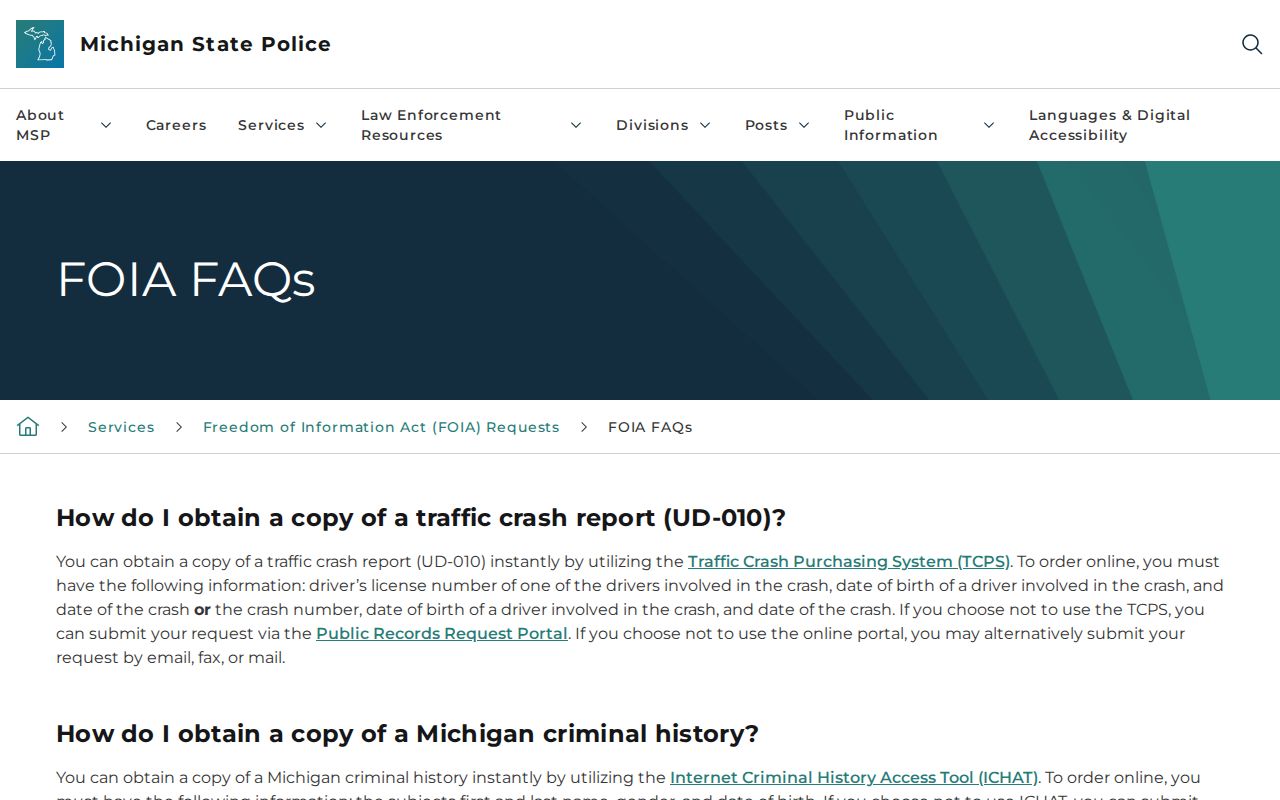
That distinction prevents a searcher from using FOIA as a slower substitute for an official portal built for the specific record.
Restricted, Sealed & Expunged Records
Michigan uses both “set aside” and “expungement.” A successful set-aside makes an eligible conviction nonpublic for ordinary purposes, though limited government uses can remain. Juvenile histories, victim data in sensitive matters, personal identifiers, suppressed cases, and sealed materials are also restricted. ICHAT excludes juvenile history, suppressed records, and warrants. Court files redact Social Security numbers and other protected information.
Application relief has eligibility limits and offense exclusions. The waiting period runs from the latest controlling event, such as sentencing, completion of probation or parole, or release from imprisonment. It is seven years for more than one felony, five years for one felony or specified serious categories, and three years for other misdemeanor application categories. The person files in the convicting court. For a Van Buren County conviction, that means the correct 7th District or 36th Circuit route, even if the person now lives elsewhere.
Van Buren Clean Slate Gaps
Michigan’s automatic Clean Slate process can make eligible convictions nonpublic without an application. Eligible misdemeanors generally use a seven-year period, while eligible felonies generally use ten years from the later of sentencing or completion of MDOC imprisonment. Statutory limits and exclusions still apply. Automatic processing became operational in 2023, but name and case matching can fail. The MSP Clean Slate record-check page describes official ways to see what remains public.
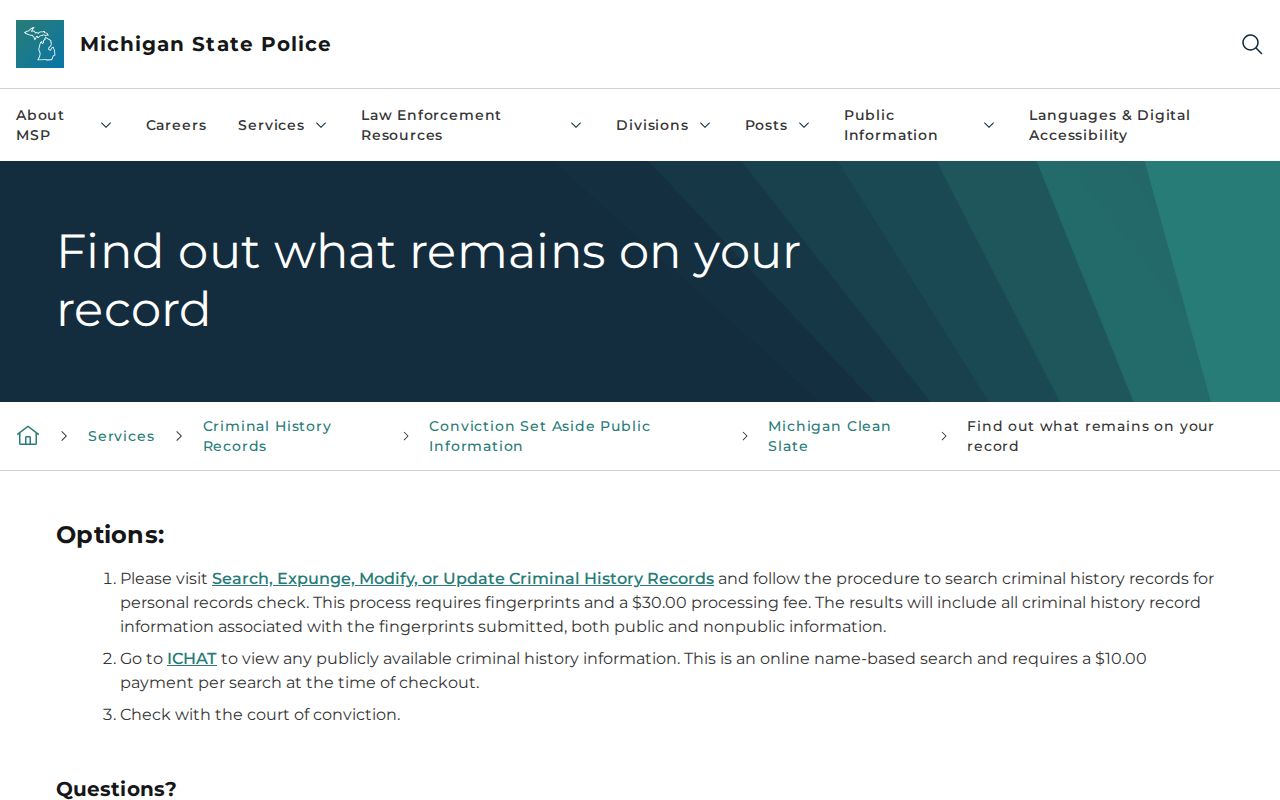
If an eligible Van Buren County item still appears, compare ICHAT, the person’s fingerprint record, and the convicting court before assuming that relief failed. The court corrects its own disposition and reports it. MSP provides a Judicial Correction Worksheet when a court cannot update electronically, plus separate contacts for criminal-history help and automatic-set-aside issues. Send certified corrections to an official system that has not updated. Do not treat an old copy, stale docket view, or missing repository update as the last word.
The MSP correction and record-review channel supplies the fingerprint review and correction route.
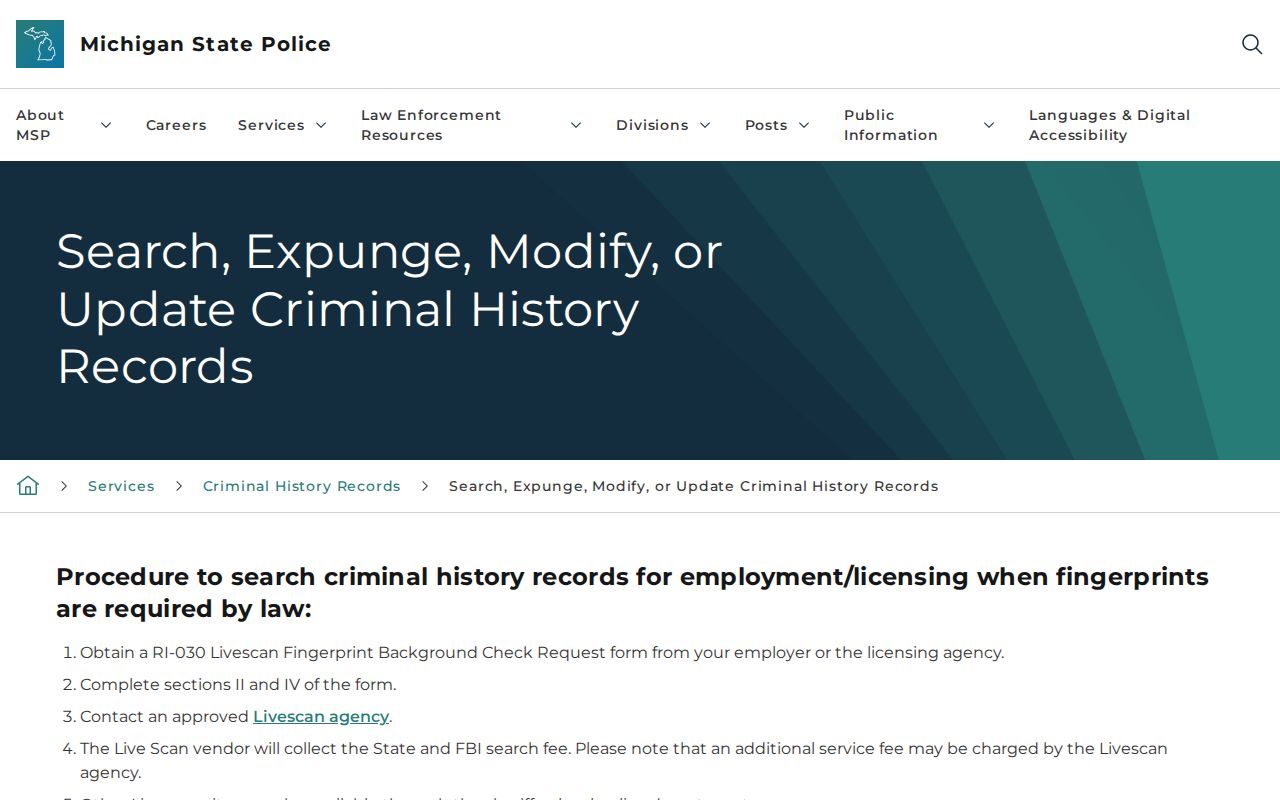
This process ties the repository entry back to the Van Buren court outcome that should support the correction.
Van Buren Warrant Record Checks
Van Buren County has no verified public countywide active-warrant portal, and ICHAT does not contain warrants. Search the 7th District and 36th Circuit indexes for a related case, then call the issuing court. Contact the sheriff to confirm a safe surrender or bond procedure. FOIA may help with releasable historical material, but an unserved or sealed warrant and active investigative records may be withheld.
Use the warrant type correctly. A bench warrant often follows a failure to appear or comply. An arrest warrant rests on a judicial probable-cause finding. A search warrant authorizes a search of a place or item and may remain sealed during an investigation. Only the court or law enforcement can confirm that a warrant was recalled, cleared, paid, served, or otherwise resolved. Do not rely on an unofficial list or approach a person believed to be wanted.
City-by-City Criminal Records in Van Buren County
Local police records begin with the agency that handled the incident, while adult criminal cases route through Van Buren County courts. South Haven has an added cross-county issue because the city extends into Allegan County. Paw Paw places village, sheriff, court, and MDOC offices within a compact area but keeps separate custodians. Hartford directs police-record requests to its city offices. Each local record check should start with the incident location and creating agency.
South Haven Record Check
2020 population 4,403 · Confirm whether the incident was on the Van Buren or Allegan side before choosing a court.
Paw Paw Record Check
2020 population 3,508 · Village police, county booking, courts, and MDOC records have distinct local custodians.
Hartford Record Check
2020 population 2,515 · Hartford police reports use the city FOIA route, while bookings and cases move to county systems.
None of the three places has a separate municipal criminal court. Van Buren County District Court remains the local adult case gateway.